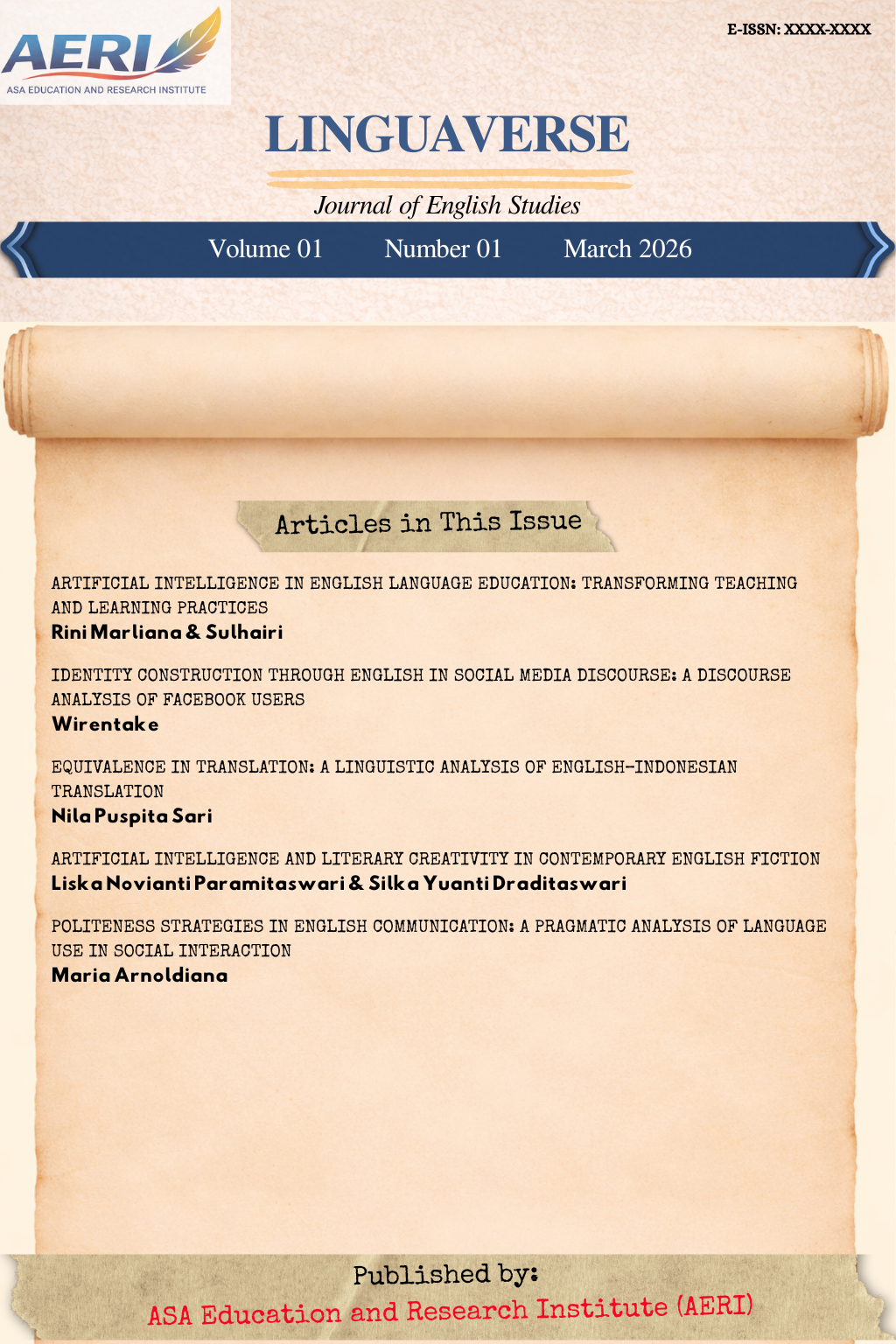
IDENTITY CONSTRUCTION THROUGH ENGLISH IN SOCIAL MEDIA DISCOURSE: A DISCOURSE ANALYSIS OF FACEBOOK USERS
Keywords:
discourse analysis, English use, identity construction, social media discourse, Facebook communicationAbstract
The rapid growth of social media has transformed the ways individuals communicate and construct their identities in digital environments. Language plays a significant role in this process because users often employ linguistic choices to express social affiliations and represent themselves in online interactions. This study investigates how English is used in Facebook discourse and how it contributes to identity construction among social media users. The study employs a qualitative research design using discourse analysis to examine Facebook posts and comments that contain English expressions. The data were collected through observation and documentation of publicly accessible Facebook interactions. The analysis focuses on three aspects, namely the forms of English use in Facebook posts and comments, the discursive strategies used to construct identity through English, and the ways English use shapes identity representation in social media discourse. The findings reveal that English appears in various forms, including full English sentences, English phrases embedded within Indonesian discourse, and code mixing between English and Indonesian. The study also finds that users employ several discursive strategies, such as expressing opinions, signaling group membership, and constructing positive self images. Furthermore, the use of English contributes to identity representation by projecting global, educational, and relational identities in online interactions. These findings suggest that English functions not only as a communication tool but also as a symbolic resource for identity construction in digital communication.
References
Barton, D., & Lee, C. (2013). Language online: Investigating digital texts and practices. Routledge.
Bucholtz, M., & Hall, K. (2016). Embodied sociolinguistics. In N. Coupland (Ed.), Sociolinguistics: Theoretical debates (pp. 173–197). Cambridge University Press.
Creswell, J. W., & Creswell, J. D. (2018). Research design: Qualitative, quantitative, and mixed methods approaches (5th ed.). Sage Publications.
Gee, J. P. (2014). An introduction to discourse analysis: Theory and method (4th ed.). Routledge.
Hartina, S., & Rivia, D. (2024). Global perspectives on social media and language evolution. Lingua: Journal of Linguistics and Language, 2(4), 237–249.
Jakaza, E. (2020). Identity construction or obfuscation on social media: A case of Facebook and WhatsApp. African Identities, 20(1), 3–25. https://doi.org/10.1080/14725843.2020.1804829
Jones, R. H., Chik, A., & Hafner, C. A. (2015). Discourse and digital practices: Doing discourse analysis in the digital age. Routledge.
KhosraviNik, M. (2017). Social media critical discourse studies. In J. Flowerdew & J. E. Richardson (Eds.), The Routledge handbook of critical discourse studies (pp. 582–596). Routledge.
Lee, C. (2017). Multilingualism online. In S. Canagarajah (Ed.), The Routledge handbook of migration and language (pp. 98–113). Routledge.
Matrood, D. T. (2024). Language and digital identity: A sociolinguistic study of online communities. Frontiers in Global Research, 2(1), 15–27. https://doi.org/10.62051/fgr.v2i1.15
Palinkas, L. A., Horwitz, S. M., Green, C. A., Wisdom, J. P., Duan, N., & Hoagwood, K. (2015). Purposeful sampling for qualitative data collection and analysis in mixed method implementation research. Administration and Policy in Mental Health and Mental Health Services Research, 42(5), 533–544. https://doi.org/10.1007/s10488-013-0528-y
Rahman, A., Gunawan, G., Said, D. R., & Mardi, M. (2025). Bilingual identity construction through social media: A study of English influenced code mixing. Jurnal Studi Guru dan Pembelajaran, 8(1), 55–67. https://doi.org/10.30605/jsgp.8.1.2025
Rosalina, A., Suhadi, J., & Pratiwy, D. (2024). Discourse criticism in social media: Youth identity representation on Instagram. Journal of English Language and Education, 9(2), 120–134. https://doi.org/10.26486/jele.v9i2
Tagg, C., Seargeant, P., & Brown, A. (2017). Taking offence on social media: Conviviality and communication on Facebook. Discourse, Context & Media, 19, 36–47. https://doi.org/10.1016/j.dcm.2017.04.008
Wagiati, W., Darmayanti, N., & Adji, M. (2024). Navigating the digital landscape: Language dynamics and digital identity among Indonesia’s contemporary generation. Jurnal Sosioteknologi, 23(1), 15–27. https://doi.org/10.5614/sostek.itbj.2024.23.1.2
Wodak, R., & Meyer, M. (2016). Methods of critical discourse studies (3rd ed.). Sage Publications.
Zahra, D. N., & Supriyanto, J. (2025). Language as social identity: A sociolinguistic analysis in a multilingual society. Al-Ufuq: Journal of Humanities and Social Sciences, 4(1), 1–12.